
On this page
Which qualifications actually matter at each grade level, where CTET fits for private schools, and the fastest honest route into a CBSE classroom.
India's school system has a confusing tangle of teaching qualifications — B.Ed., D.El.Ed., NTT, ECCEd, CTET, state TETs — and most advice online is written for government-school recruitment, which follows different rules from private CBSE schools. Here's how it actually works if your goal is a teaching job in a private CBSE school.
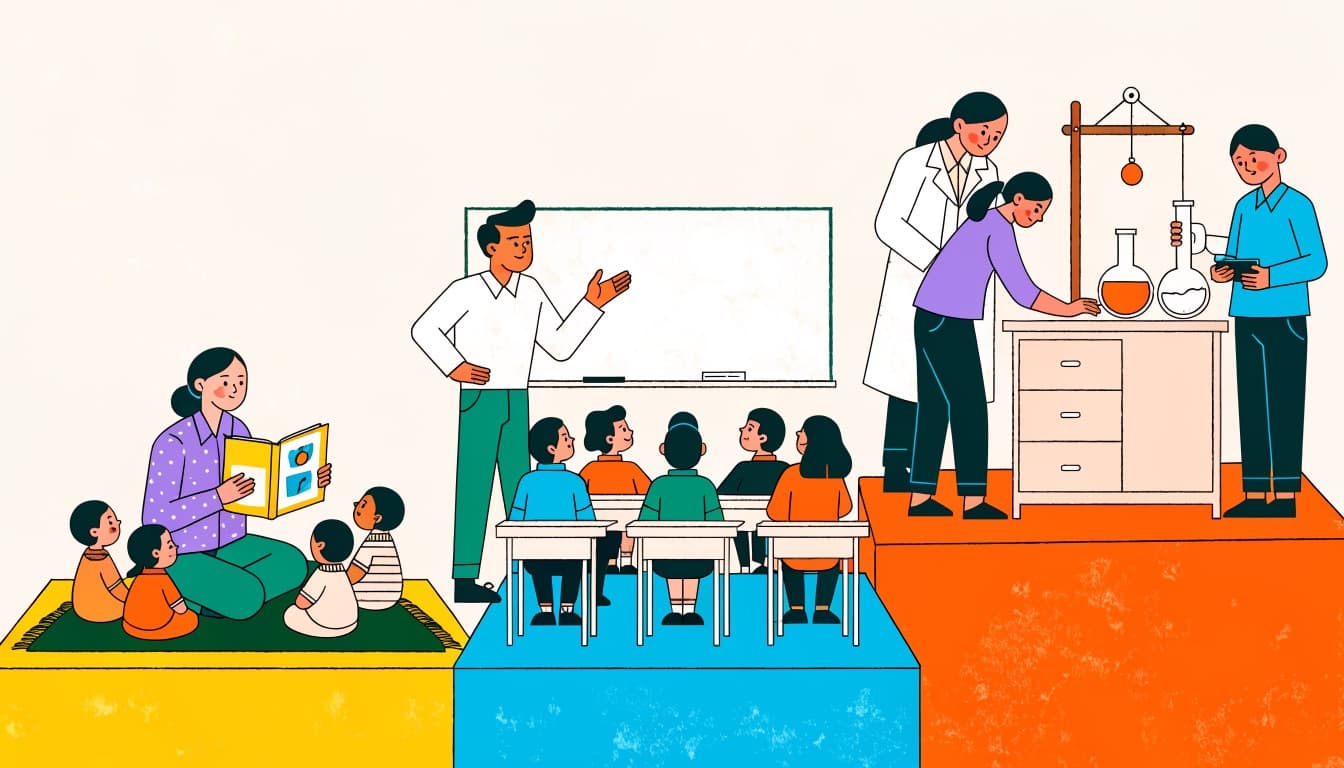
The qualification rules, grade by grade
| Level | Degree | Professional qualification |
|---|---|---|
| Pre-primary (Nursery–KG) | Any bachelor's degree (often flexible) | NTT, ECCEd, Montessori diploma or D.El.Ed. |
| Primary / PRT (Grades 1–5) | Bachelor's degree (≥50%) | D.El.Ed. or B.Ed.; B.El.Ed. also accepted |
| TGT (Grades 6–8, and often 9–10) | Bachelor's degree in the teaching subject (≥50%) | B.Ed. |
| PGT (Grades 11–12) | Master's degree in the teaching subject (≥50%) | B.Ed. |
The pattern to notice: your degree must match the subject you want to teach at TGT/PGT level. A B.Sc. in Physics plus a B.Ed. qualifies you for TGT Science; to teach Physics to Grade 12 you'll need an M.Sc. in Physics. At primary level, subject match matters less than the professional qualification.
Does CTET matter for private schools?
Short answer: it's mandatory for central government schools (KVS, NVS) and increasingly requested — but not universally enforced — in private CBSE schools. CBSE's affiliation by-laws direct affiliated schools to prefer TET-qualified candidates, and the best schools treat CTET as a strong positive signal. In practice, a candidate with a good B.Ed., a strong demo lesson and no CTET will still get hired at most private schools.
Our advice: if you're early in your career, take CTET Paper 1 (for Grades 1–5) or Paper 2 (for Grades 6–8). It costs little, it's valid for life, and it future-proofs you for government options while making your private-school CV stronger.
The honest routes into a classroom
Route 1: the standard path
Bachelor's degree → 2-year B.Ed. → apply during the December–April hiring season. This remains the most reliable route, and the 4-year integrated B.Ed. (ITEP) now compresses it for students straight out of Class 12.
Route 2: early-years specialisation
A Montessori, ECCEd or NTT diploma (typically 1 year) gets you into pre-primary classrooms fastest, and demand for trained early-years educators currently outstrips supply in most Indian cities. Many educators later add a B.Ed. part-time to open up primary and middle-school roles.
Route 3: experience-first
Some schools — NCFE included — will consider candidates without a B.Ed. for roles below Grade 9 if they bring 3+ years of strong, verifiable teaching experience (tutoring centres, ed-tech, assistant-teacher roles count). For Grades 9–10 upward, CBSE norms are strict and there is no way around the B.Ed. Read our FAQ for exactly how we apply this.
Route 4: internships and fresher programmes
A growing number of schools run paid teaching internships or fresher cohorts — a structured way to test whether teaching suits you before committing to a B.Ed. NCFE runs an 8-week paid summer teaching internship with conversion offers for top performers; see open internship roles.
What schools look for beyond the certificate
- Subject depth — can you answer the question two levels above the textbook?
- Classroom presence — assessed in the demo lesson, not the interview chair.
- Communication with parents — increasingly a screening criterion, since it's where new teachers most often struggle.
- Comfort with technology — schools going AI-native (as we are) look for teachers willing to use tools for planning and assessment, not teachers replaced by them.
We hire teachers across pre-primary to Grade 12, run a paid summer internship for freshers, and publish our salary bands before you apply.
Browse teaching vacancies →