
On this page
The demo lesson decides more hiring outcomes than the interview does. Here's what the people at the back of the room are actually writing down.
In most serious schools, the demo class outweighs everything else in the process. A shaky interview with a superb demo gets an offer; a polished interview with a flat demo does not. Yet most candidates prepare ten hours for the interview and one for the demo. Invert that.
What a demo class actually is
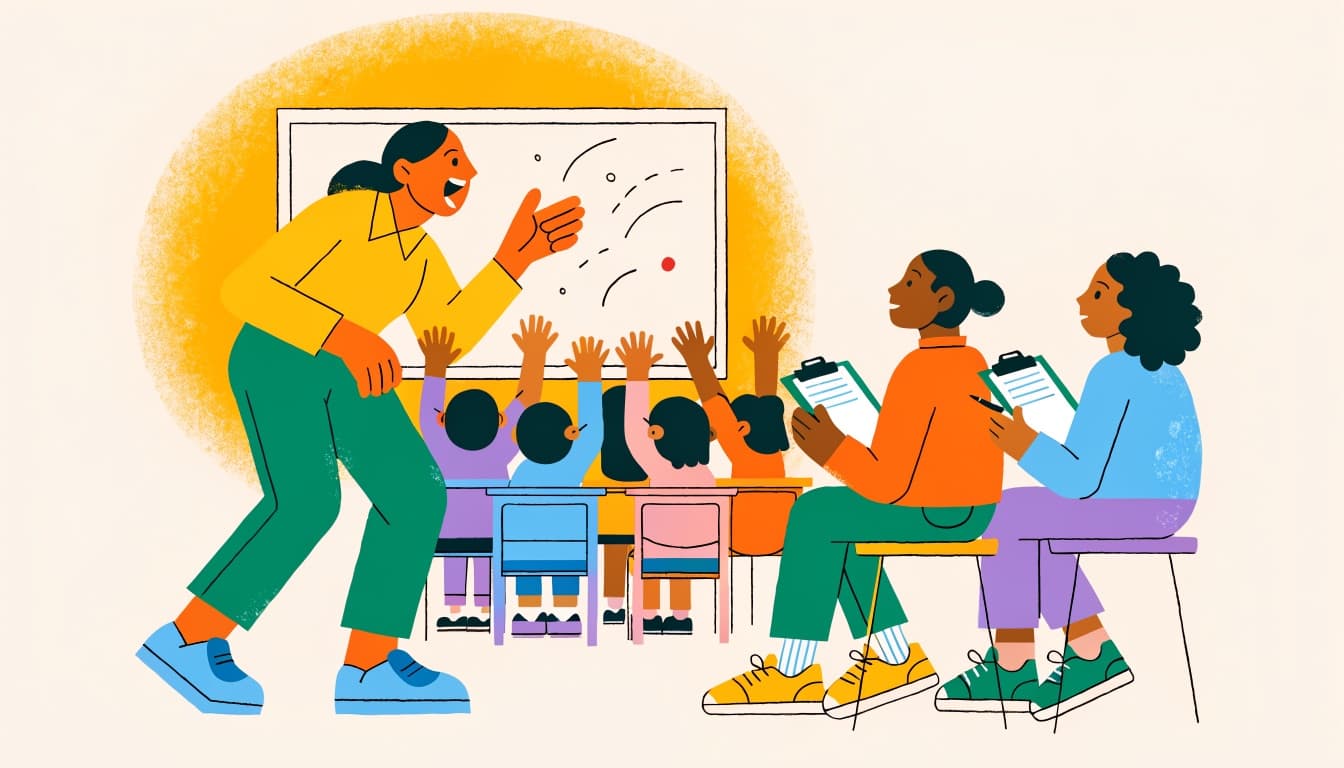
Typically 20–30 minutes with a real class of students you've never met, on a topic given to you 1–3 days in advance (sometimes on the spot), while 2–3 observers — usually the principal, coordinator and a senior subject teacher — watch from the back. They know the students; you don't. That asymmetry is the point: they're watching how you establish a relationship with a cold room.
The checklist observers actually use
Formats vary, but nearly every observation sheet reduces to five questions:
- 1Opening (first 3 minutes): did you get every student's attention before starting content? Did you open with a hook — a question, object, story, contradiction — or with "turn to page 47"?
- 2Student engagement: in 20 minutes, how many students spoke, wrote, or did something? A demo where only the teacher performs scores zero here, however brilliant the performance.
- 3Subject accuracy and depth: was everything you said correct, and could you handle the curveball question? (Observers often plant one.)
- 4Checking for understanding: did you find out whether they learned it — cold-calling, quick writes, a one-question exit check — or did you just ask "understood?" at the room?
- 5Presence: voice, movement, board work, names. Did you use students' names within the first ten minutes? (Asking names and then using them is the single cheapest high-signal move available.)
Designing your 20 minutes
Plan one small thing taught completely, rather than a chapter taught shallowly. A reliable structure:
- Minutes 0–3 — hook and frame. A question or demonstration that creates a need to know. State plainly what they'll be able to do by the end.
- Minutes 3–12 — teach the concept, with at least two student interactions: a think-pair-share, a prediction, a quick problem on mini-whiteboards or notebooks.
- Minutes 12–17 — students do the thing while you circulate. This is where observers upgrade you from presenter to teacher.
- Minutes 17–20 — check for understanding and close the loop back to your hook. An exit question every student answers beats a rhetorical summary.
The five mistakes that sink good teachers
- Teaching to the observers. Your audience is the 12-year-olds, not the principal. Eye contact with the back of the room reads as insecurity.
- Over-relying on a PPT. If the projector fails (it will, someday), you should still have a lesson. Many schools deliberately offer only a board.
- Covering too much. Racing through content to "finish" guarantees no student interaction — the highest-weighted item on the sheet.
- Ignoring the quiet half. Taking answers only from the four eager hands signals you'll leave the rest behind all year.
- No plan for wrong answers. "No, anyone else?" is the worst response in teaching. Wrong answers are your best material: explore why the mistake is tempting.
If the topic is given on the spot
Some schools hand you the topic 15 minutes before. Don't panic-plan content — plan structure. Your hook, interaction pattern and exit check work for any topic; only the middle changes. Schools that do this aren't testing preparation, they're testing whether the craft is internalised.
“In twenty years of watching demos, the tell is always the same: does the candidate look at the students' work while circulating, or at their watch? You can't fake being interested in whether kids got it.”
The demo is one of four stages in our process (application → intro call → demo → campus visit) — the full picture, including how we handle the interview stage, is in our guide to teacher interview questions.
Every teaching hire at NCFE includes a demo lesson with real students — and we tell you exactly what we're looking for beforehand, because gotchas select for luck, not craft.
Apply for a teaching role →